
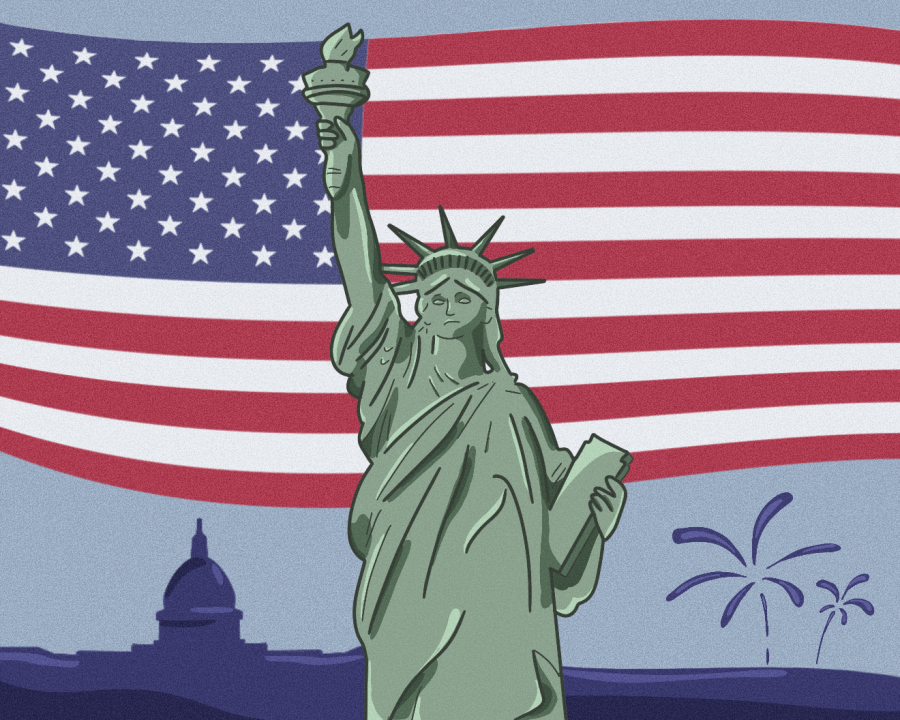



















The American Dream; something everyone is familiar with. An idealistic lifestyle; goals for where we want to be one day. Throughout history, the American Dream has come to be associated with wealth and high social status. When you ask people about their version of the American Dream nearly all will respond with some sort of version of high society, the classic American success story, or the self-made man. Many also associated the phrase with the land of opportunity for all, including immigrants and refugees. Even the prestigious Oxford English Dictionary defines the American Dream as, “the ideal that every citizen of the United States should have an equal opportunity to achieve success and prosperity through hard work, determination, and initiative.”
While the American Dream has always been both an idea and an ideal, for all its complications, it has had a powerful role in shaping the values and goals of the U.S. as well as those of people far beyond its borders.
In her 2018 book Behold America, University of London historian Sarah Churchwell traced the term “American Dream’ to at least as early as 1895. By the early 1900s, it was often interconnected with Americans‘ appreciation and desire for new consumer goods, such as furniture and clothing.
The American Dream slogan was repopularized by famous historian James Truslow Adams in his 1931 book The Epic of America. In his mind, it was “a dream of social order in which each man and each woman shall be able to attain to the fullest stature of which they are innately capable, and be recognized by others for what they are, regardless of the fortuitous circumstances of birth or position.”
I believe that in this modern day and age, everyone has a different perspective of what the American Dream means, since everyone has slightly different circumstances and aspirations. While some view the American Dream with a more pessimistic outlook, such as the perspective of associate professor of history, Traci Parker who said, “In all honesty, it’s a facade. It’s like you could buy your way into the American Dream.” Others view it with a more optimistic mindset, seeing it as the goals for both individuals and our nation as a whole. Goals such as equality for everyone regardless of gender, race, religion, etc. Goals such as no one having to worry about when they will next be able to eat a proper meal. Goals such as no one having to be left out in the cold simply because they can’t afford somewhere to stay.
A key impact on your perspective of the American Dream is your past. We all have different experiences and histories. Although we personally haven’t experienced all our history from a first-hand perspective, it has still had a role in shaping us as who we are to this day. Our ancestors and what they did has believe it or not, shaped us and our family.
One of the core aspects of the American Dream is this idea of success, of “pulling yourself up by your bootstraps” – that if you work hard enough and do what you’re supposed to do, success is achievable. For many Americans, this might translate to earning more money, owning property, getting a sought after position at work, and possibly for some, finding a partner and starting a family.
As someone once said, “Whether you’re right, center, left – everybody wants their children to have a better life than they did.” The unfortunate reality, though, is that in our country’s current state, that isn’t always possible for everyone.
For many immigrants, the American Dream isn’t solely about success or economics. As Dosman from the Letters and Science article, said, “Most people have come to the United States of America to have a better life. For some, that’s economic prosperity. For some, that’s having your white picket fence, your house that you own, your dog, and your 2.5 children that you see on TV. For others, it’s just being able to survive and knowing that your children are going to be safe and away from violence.”
According to the United Nations, by the end of 2022, over a million people were uprooted from their homes in Central America due to violence, instability, and persecution. Gang violence, political turmoil, threats, extortion, persecution, and sexual violence have forced hundreds of thousands of people to flee their homes in search of safety and a better life.
According to Ariana Valle, an assistant professor of sociology, “There’s a safety element to the American Dream that’s really important for people escaping authoritarian regimes.”
In conclusion, the American Dream is different for everyone. While many core values of our present–day American Dream may be the same as or similar to those of the original American Dream, like any goal or dream, it has evolved and changed with each generation. Leading to everyone having a different perspective on it. A perspective shaped by their past, present, and future.
Real World Perspectives
Letters and Science magazine asked college students what they think of when they hear the American Dream. I’ve included some of their responses below.
“To me, the American Dream serves as an idealistic pursuit of building wealth through hard work. I truly want to believe that regardless of background, we can all succeed, and to an extent that’s true. In modern times, I think the ideal is just that, an ideal that can bring hope or enforce structural barriers.”
— Xavier Gonzalez, major in computer science and cinema & digital media
“The American Dream, for us, is humble, the result of the courage of leaving everything behind for the chance at something better. It is not about taking — it’s about giving, about providing themselves and their children with the opportunity for a life of choice.”
— Melanie Diaz, major in medicinal chemistry and drug design
“The American dream is a promise for greater opportunities in the face of effort and sacrifice. The promise drives masses of people to the United States year in and year out because of this expectation of opportunity and the desire to advance one’s economic status. This dream however is currently under threat as the cost of living outpaces wages and the assaults on undocumented peoples throughout the nation.”
— Brandon Gonzalez Arenas, major in political science and Chicana/o studies
Citations
Churchwell, Sarah. “A Brief History of the American Dream.” George W. Bush Presidential Center, 21 Nov. 2022, www.bushcenter.org/catalyst/state-of-the-american-dream/churchwell-history-of-the-american-dream.
Diamond, Anna. “The Original Meanings of the ‘American Dream’ and ‘America First’ Were Starkly Different from How We Use Them Today.” Smithsonian Magazine, Oct. 2018, www.smithsonianmag.com/history/behold-america-american-dream-slogan-book-sarah-churchwell-180970311/.
Russell, Alex, and Maria Sestito. “What Was the American Dream? | Lettersandsciencemag.” Letters and Science, 2 July 2025, lettersandsciencemag.ucdavis.edu/feature/what-was-american-dream.