



















As of April 22, 2025 the FDA (Food and Drug Administration) has announced plans to “phase out” six synthetic petroleum-based food dyes: Blue 1, Blue 2, Green 3, Red 40, Yellow 5, and Yellow 6, by the end of 2026. FDA Commissioner Martin Makary has said they plan to “phase out” other, lesser-used dyes, namely Orange B and Citrus Red 2 in the coming months as well. The FDA has also said they will request the food and beverage industry remove Red 3 before the previously announced compliance deadline of 2027.
However, the FDA isn’t issuing a complete ban on food dyes just yet, they expect food manufacturers to comply with the agency’s request to remove these food dyes voluntarily. In replacement of harmful food dyes the agency has plans to authorize four natural dyes and expedite approval of natural dyes. For more information on synthetic food dyes and the FDA’s plans keep reading.
What are synthetic food dyes?
Most of the commonly used food colors are synthetic petroleum-derived chemicals that aren’t by any means natural. You might recognize that word petroleum and I’ll tell you why. It’s because it’s the same chemical that cars run on, literal gasoline.
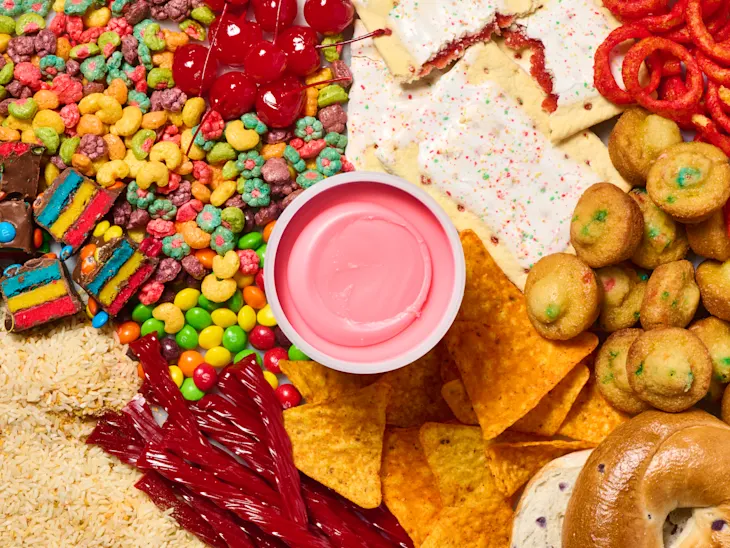
These synthetic dyes often are substituted for real, nutritious ingredients, such as fruits and vegetables, and are most commonly used to make foods more vibrant and attractive, especially those that are manufactured and marketed for children. Dyes don’t keep food from spoiling or fend off bacteria that can cause food poisoning. Their sole purpose is to help food companies make a profit by selling fun brightly colored food. It doesn’t help that the foods that generally contain food dyes are also high in sweeteners/sugar, salt, and fat.
Since synthetic food dyes such as Blue 1, Blue 2, Green 3, Red 40, Yellow 5, Yellow 6 are commonly found on store shelves and in school meals, you and your family likely consume them on the regular and with them comes the health problems and risks of eating them.
The risks of synthetic dyes:
Accumulating evidence has shown that in children synthetic food dyes can cause neurobehavioral issues, including hyperactivity and inattention. One example of this evidence is from the 2021 experiment that was conducted by the California Office of Environmental Health Hazard Assessment (OEHHA). In this trial the OEHHA conducted a comprehensive, systematic review of the evidence, including 27 human clinical trials plus a number of animal and in vitro, and concluded that the seven most widely used synthetic food dyes: Blue 1, Blue 2, Green 3, Red 3, Red 40, Yellow 5, and Yellow 6, can cause or further neurobehavioral problems in children. OEHHA has made it clear that these types of neurobehavioral problems can make it difficult for kids that have been impacted to succeed in school and socially.
OEHHA also raised concerns about how these unnecessary color additives were approved by the FDA in the first place. OEHHA found that the “safe intake levels” set by the FDA regarding synthetic food dyes may not be strict enough to sufficiently protect children from the effects of synthetic food dyes.
Bigger Issues at the FDA:
The FDA has an ongoing responsibility to protect consumers from harmful food chemicals and products. However, the agency is facing massive cuts to staffing that threaten health and food safety for everyone. Health Secretary Robert F. Kennedy, Jr, has announced thousands of layoffs across the Department of Health & Human Services.
According to Dr.Peter G.Lurie, President of the Center for Science in the Public Interest, “The cuts are arbitrary, sweeping, and will be devastating to the FDA’s food and medical product programs, leaving the FDA’s teams who communicate about and prevent foodborne outbreaks, ban dangerous food chemicals, and ensure the safety and effectiveness of medical products scrambling to operate.” Overall, the massive cuts to staffing will impact the public as the safety of our food will be at risk due to the declining amount of staff who are struggling the maintain operation at an efficient rate.
Fixing the main concerns regarding food chemicals safety:
The FDA and Congress have a ways to go to reform the broken food chemical regulatory system that has since allowed synthetic dyes to remain in use for so long after we knew they were unsafe.
The agency has failed to effectively monitor the safety of chemicals after they come to market, which is one of the main reasons why, after many years of prompting by many including the CSPI, in 2024 agency announced plans to develop an enhanced framework for conducting post-market assessments of food chemicals safety.
It is crucial for the safety of consumers that the FDA builds on the existing restrictions regarding food dyes by instituting broader reforms to the food chemicals regulatory system.
Ways to avoid consuming food dyes:
Foods such as candies and brightly colored drinks that you know are unhealthy probably pop to mind. However foods such as flavored yogurt, apple sauce, fruit cups, chips, crackers, trail mix, packaged baked goods containing fruit, and granola and protein bars contain food dyes as well as all the junk food you first think of.
In one study, researchers found nearly all candy and fruit-flavored snacks contained synthetic food dyes. Across practically all food categories, food dye could be found in nearly 2 in 5 products in the store with the exception of fresh produce.
How can you best steer clear of these food dyes that are seemingly everywhere then?
- Lower your consumption of packaged foods: Artificial dye is an ingredient in ultra-processed packed foods. While your go to brand may not have a dye-free option, another company might.
- Read labels on packages: The best way to know what is in any food is to read the ingredients label. Dyes are often but not always listed last and are sometimes listed under other names such as Allura Red AC instead of Red 40 and Tartrazine instead of Yellow 5.
- Cut back on soda consumption: Soda is a huge source of exposure to artificial food dye, not to mention other harmful chemicals, such as artificial sweetener.
- Choose USDA-certified foods: Processed foods with this label CAN’T contain artificial food dyes.
- Embrace a variety in your diet: The greater the variety, the less exposure you’ll risk to specific problematic ingredients or contaminants.
- Healthy Swaps: Some substitute foods are nearly indistinguishable from the artificially enhance version.
- Instead of flavored yogurt, mix fresh fruit with plain Greek yogurt.
- Instead of packaged trail mix or granola, try making your own with undyed fruits and nuts.
- Eating oatmeal in the morning topped with cinnamon and fresh fruit, can substitute for artificially dyed cereal.
- Pairing dark chocolate and nuts makes for a great treat.
- You can even make crackers, cookies, ice cream, and popsicles at home – it’s both healthier and less expensive than buying premade ones from the store.
Citations:
Galligan, Thomas, et al. “FDA’s ‘plan’ to Remove Food Dyes: Industry ‘Understanding.’” Center for Science in the Public Interest, 5 May 2025, www.cspi.org/cspi-news/fdas-plan-remove-food-dyes-industry-understanding.
8 Ways to Avoid Giving Your Kids Food with Artificial Coloring | Environmental Working Group, www.ewg.org/news-insights/news/2024/08/8-ways-avoid-giving-your-kids-food-artificial-coloring. Accessed 5 Dec. 2025.